


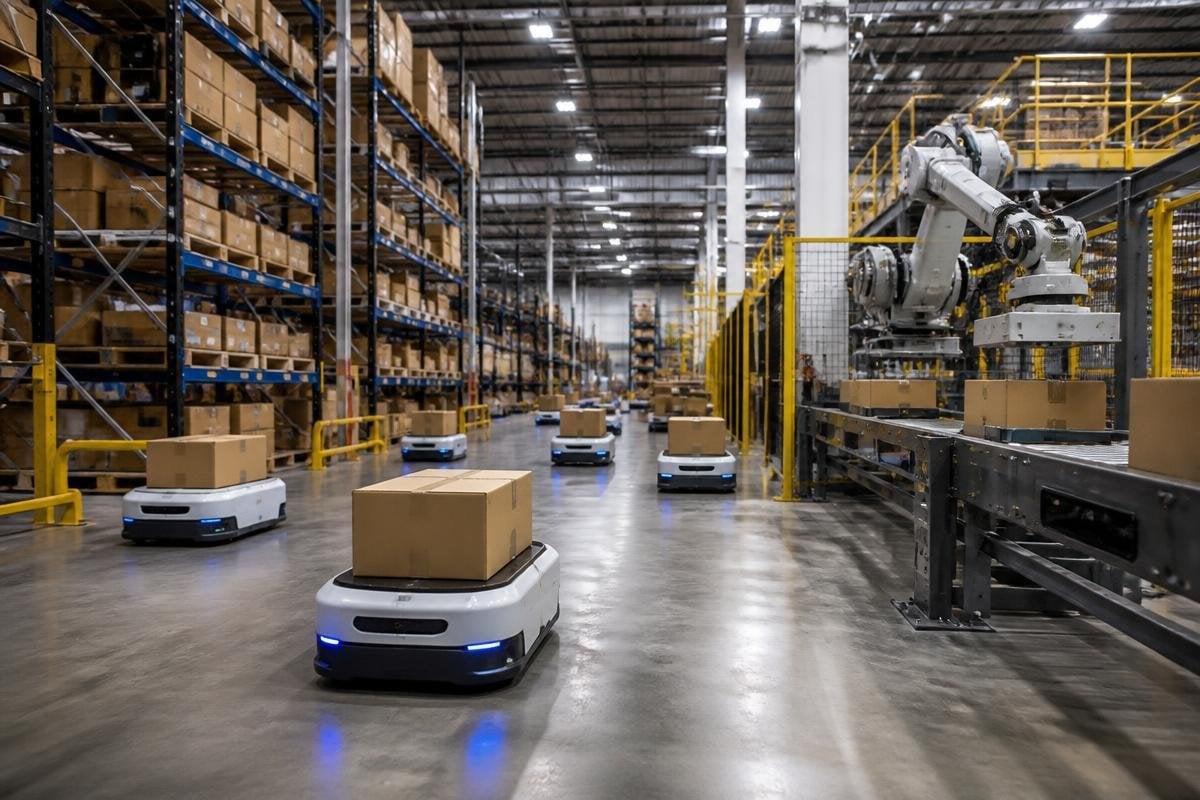
A fully robotic warehouse would have no person driving a forklift, picking each box, or carrying stock between storage and packing. People would still plan the work, fix failed equipment, handle unusual orders, and manage safety.
The change would happen across the whole building. Software would assign jobs, mobile robots would move goods, robotic arms would handle items, and fixed systems would sort orders before shipment.
Quick read
- Mobile robots move shelves, bins, or pallets to work areas
- Robotic arms handle repeatable items, with people helping on hard-to-grip products
- The building still needs technicians, safety staff, and people who manage exceptions
The warehouse starts with software
The first layer is the warehouse management system. It records stock, customer orders, storage locations, and shipping deadlines. A second system turns those orders into jobs for robots and other equipment.
That software would decide which robot should move a shelf, which arm should pick a product, and which route keeps traffic moving. It also needs live data from cameras, barcode scanners, weight sensors, and robot status reports.
A bad stock record can stop the whole chain. If the system says a bin is full when it is empty, a robot may send the wrong job to an arm. The machine can work as instructed and still produce the wrong result.
Movement without forklifts
Autonomous mobile robots would carry shelves, bins, totes, or pallets through marked areas. They use sensors such as LiDAR, cameras, and wheel encoders to locate themselves and avoid people or other machines.
Some robots would bring goods to a fixed work station. Others would carry completed orders to packing or move empty containers back to storage. The software must manage right-of-way, charging, blocked paths, and robots that stop with a load.
Pallet work needs different equipment. A robotic pallet truck may lift and place loads, while a robotic arm may stack cartons in a set pattern. Floor condition, pallet quality, and load weight can affect whether the task works without help.
Picking changes the problem because the robot must find one item among many and grip it without damage. Reports from Robot 24 can tie those claims to named systems, test settings, and measured results. That evidence leads into the harder question: can the robot repeat the task when the item and its position change?
Picking is the hard part
Moving a known box from one marked place to another is easier than picking mixed products from a crowded bin. The arm has to find an item, choose a grip, lift it without damage, and place it in the right order container.
Grippers work well when products have known shapes and packaging. They have a harder time with soft bags, clear plastic, tangled cables, reflective surfaces, or items partly hidden under other products.
A camera can help the robot see the item, but vision does not solve every handling problem. The arm still needs a safe path, enough force, and a way to detect a slip. A person may remain at the station for rare items or failed picks.
What still needs people
A building can run with few people on the floor while depending on people elsewhere. Technicians replace worn parts, clear jams, inspect sensors, and check charging equipment. Engineers update software and review records from failed tasks.
Safety work also stays human-led. Teams must set robot speeds, mark walkways, test emergency stops, and decide what happens when a person enters a robot area. Local rules and site conditions affect the design.
The system must also handle exceptions. A damaged carton, missing barcode, wrong item, blocked door, or late truck can break the planned flow. Good automation gives each case a clear handoff instead of waiting for a robot to guess.
A practical decision guide
Before planning a warehouse with fewer people on the floor, check these points:
- Stock data: Can the software show the right item and location?
- Product mix: Are the goods firm, visible, and easy to grip?
- Floor plan: Do robots have clear routes, safe crossings, and charging space?
- Failure work: Who clears jams, fixes sensors, and handles damaged stock?
- Order changes: Can the system react when a priority order or late truck appears?
- Proof: Has the full process worked at the intended speed, not only in a short demo?
A warehouse that passes these checks may automate much of its daily movement.
It still needs a plan for work that falls outside the normal pattern, because that work is where robots have the least room to make a safe guess.
I’d wait for a site to show its full error-handling process before calling it fully robotic. The useful test follows one order through storage, packing, and truck loading, then asks what happens when the first pick fails.